
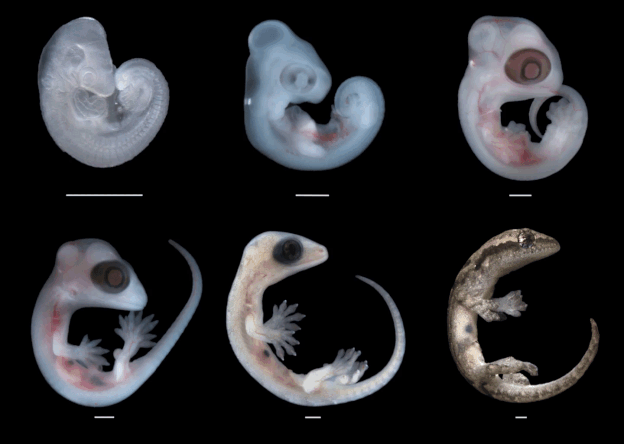
Embryonic staging series, also known as normal staging tables, are detailed descriptions of embryonic development that are foundational resources for evo-devo research. With this page, I aim to curate our current knowledge about gecko embryonic development.
Stay tuned!
If you use these embryonic staging series, please cite them accordingly.
Stay tuned!
If you use these embryonic staging series, please cite them accordingly.
Published Gecko Embryonic Series
Published by myself and collaborators:
Mourning gecko (Gekkonidae: Lepidodactylus lugubris)
Leopard gecko (Eublepharidae: Eublepharis macularius)
Mourning gecko (Gekkonidae: Lepidodactylus lugubris)
- Griffing AH, Sanger TJ, Daza JD, Nielsen SV, Pinto BJ, Stanley EL, Gamble T. 2019. Embryonic development of a parthenogenetic vertebrate, the mourning gecko (Lepidodactylus lugubris). Developmental Dynamics 248:1070–1090. FOUND HERE
- Griffing AH, Sanger TJ, Epperlein L, Bauer AM, Cobos A, Higham TE, Naylor E, Gamble T. 2021. And thereby hangs a tail: Morphology, developmental pattrns, and biomechanics of the adhesive tails of crested geckos (Correlophus ciliatus). Proceedings of the Royal Society B 288:20210650. FOUND HERE
- Griffing AH, Gamble T, Bauer AM, Russell AP. 2022. Ontogeny of the paraphalanges and derived phalanges of Hemidactylus turcicus (Squamata: Gekkonidae). Journal of Anatomy 241:1039–1053. FOUND HERE
- Griffing AH, Gamble T, Behere A, Higham TE, Keller GM, Resener J, Sanger TJ. 2024. Developmental patterns underlying variation in form and function exhibited by house gecko toe pads. Integrative & Comparative Biology: Accepted.
- Griffing AH, Gamble T, Behere A, Higham TE, Keller GM, Resener J, Sanger TJ. 2024. Developmental patterns underlying variation in form and function exhibited by house gecko toe pads. Integrative & Comparative Biology: Accepted.
Leopard gecko (Eublepharidae: Eublepharis macularius)
- Wise PAD, Vickaryous MK, Russell AP. 2009. En embryonic staging table for in ovo development of Eublepharis macularius, the leopard gecko. The Anatomical Record 292:1198–1212. FOUND HERE
- Alturk WI, Khannoon ER. 2020. Ontogeny of the Moorish gecko Tarentola mauritanica with emphasis on morphogenesis of the skin and its derivatives. Journal of Experimental Zoology, Part B: Molecular and Developmental Evolution 334:294–310. FOUND HERE
- Khannoon ER. 2015. Developmental stages of the climbing gecko Tarentola annularis with special reference to the claws, pad lamellae, and subdigital setae. Journal of Experimental Zoology, Part B: Molecular and Developmental Evolution 324:450–464. FOUND HERE
- Noro M, Uejima A, Abe G, Manabe M, Tamura K. 2009. Normal developmental stages of the Madagascar ground gecko Paroedura pictus with special reference to limb morphogenesis. Developmental Dynamics 238:100–109. FOUND HERE
- van der Vos W, Stein K, Di-Poï N, Bickelmann C, Penner J. 2018. Ontogeny of Hemidactylus (Gekkota, Squamata) with emphasis on the limbs. Zoosystematics and Evolution 94:195–209. FOUND HERE
- Zhao R-N, Zhang L-Y, Wu P-F, Ping J, Jin J-Y, Zhang Y-P. 2017. The morphological characteristics of embryos at different developmental stages in the Japanese gecko, Gekko japonicus. Chinese Journal of Zoology 52:987–995. FOUND HERE
Lepidodactylus lugubris — mourning geckos
Mourning geckos are a widespread species native to Southeast Asia, the Pacific islands, and northeastern Australia. They are parthenogenetic, meaning the species is entirely composed of females, which give brith to genetically identical clones. Males are rarely born and are generally sterile. Like other geckos in Gekko clade, they are generally arboreal and exhibit adhesive toe pads along the base of their digits. This gecko is a very tractable laboratory animal and a perfect choice for lizard evo-devo research! In 2018, collaborators and I described laboratory husbandry and embryo collection. The following year, we described in ovo embryonic development. We have also briefly described pigment development, the development of tail scales, and toe pad development in this species.
Mourning geckos are a widespread species native to Southeast Asia, the Pacific islands, and northeastern Australia. They are parthenogenetic, meaning the species is entirely composed of females, which give brith to genetically identical clones. Males are rarely born and are generally sterile. Like other geckos in Gekko clade, they are generally arboreal and exhibit adhesive toe pads along the base of their digits. This gecko is a very tractable laboratory animal and a perfect choice for lizard evo-devo research! In 2018, collaborators and I described laboratory husbandry and embryo collection. The following year, we described in ovo embryonic development. We have also briefly described pigment development, the development of tail scales, and toe pad development in this species.
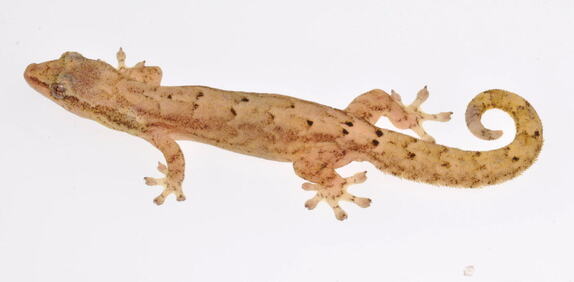
An adult mourning gecko (Lepidodactylus lugubris).
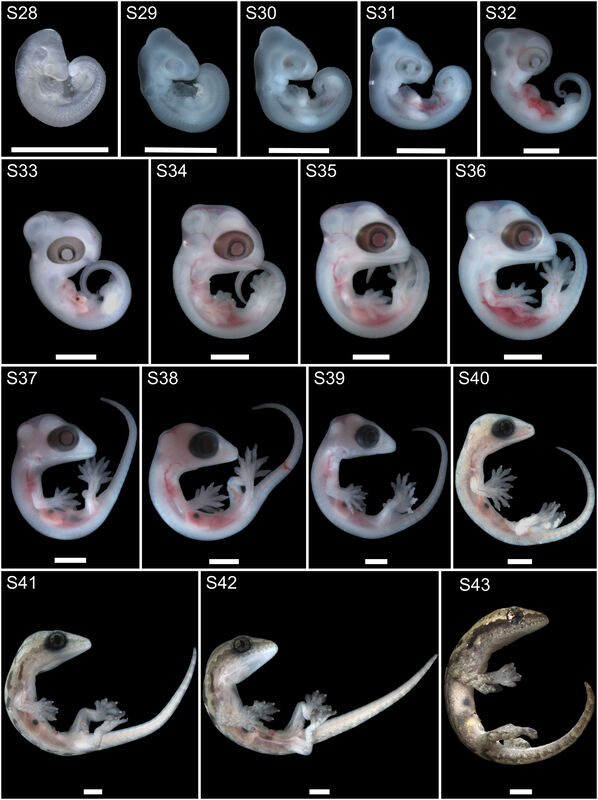
Sixteen embryonic stages of mourning gecko (Lepidodactylus lugubris) in ovo development. Scale = 2mm.
Correlophus ciliatus — crested geckos
Crested geckos are a large species of gecko native to New Caledonia — a series of islands in the southern Pacific Ocean. Until the mid-1990s, this species was presumed extinct. Since then, their incredible success in captivity has made them one of the most common species in the commerical reptile trade. Crested geckos are generally arboreal and exhibit adhesive pads along the bottoms of their digits as well as the tip of their tail. Because pygopodoid geckos (diplodactylids, pygopodids, and carphodactylids) are the sister clade to the remaining gecko families, this is an ideal species to use for comparative gecko evo-devo! In 2021, this became the first species of the gecko family Diplodacytlidae to have an embryonic staging series. By characterizing embryonic development, we were able to observed toe pad and tail pad development to assess serial homology and developmental constraints. Recently, we compared these toe pad data with other padded lizards to identify conserved and derived patterns in lizard digit development. This species was also the focus of our recent collaborative paper, investigating tuning mechanisms of the gecko inner ear.
Crested geckos are a large species of gecko native to New Caledonia — a series of islands in the southern Pacific Ocean. Until the mid-1990s, this species was presumed extinct. Since then, their incredible success in captivity has made them one of the most common species in the commerical reptile trade. Crested geckos are generally arboreal and exhibit adhesive pads along the bottoms of their digits as well as the tip of their tail. Because pygopodoid geckos (diplodactylids, pygopodids, and carphodactylids) are the sister clade to the remaining gecko families, this is an ideal species to use for comparative gecko evo-devo! In 2021, this became the first species of the gecko family Diplodacytlidae to have an embryonic staging series. By characterizing embryonic development, we were able to observed toe pad and tail pad development to assess serial homology and developmental constraints. Recently, we compared these toe pad data with other padded lizards to identify conserved and derived patterns in lizard digit development. This species was also the focus of our recent collaborative paper, investigating tuning mechanisms of the gecko inner ear.
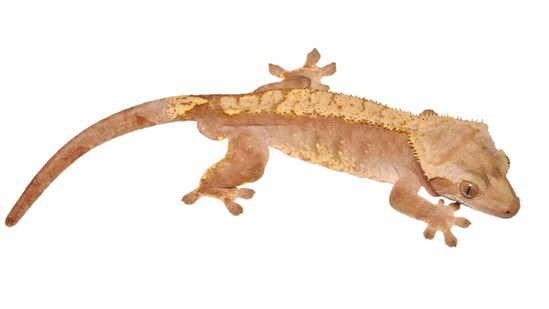
An adult crested gecko (Correlophus ciliatus)
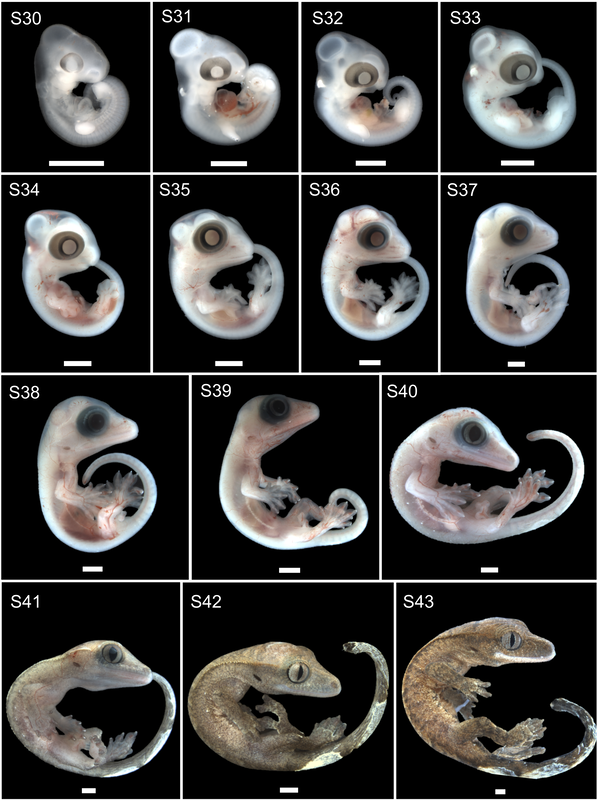
Fourteen developmental stages of Correlophus ciliatus. Scale bars = 2 mm.
Hemidactylus turcicus — Mediterranean house geckos
Mediterranean house geckos are moderate-sized geckos native to (you guessed it) the Mediterranean region and is introduced to most of the southern United States and northern Mexico. Given their dense numbers in urban settings across the souther US, we reckon these critters would serve as an excellent study system for developmental studies. These house geckos likely owe their amazing ability to establish themselves in novel/urban environments due to their adhesive digits. Sitting just above these sticky toe pads are derived phalanges and enigmatic elements called paraphalanges. In 2022, we described the skeletal development of these structures in a comparative context. We also previously investigated the external morphology of their toe pads across embryonic development.
Mediterranean house geckos are moderate-sized geckos native to (you guessed it) the Mediterranean region and is introduced to most of the southern United States and northern Mexico. Given their dense numbers in urban settings across the souther US, we reckon these critters would serve as an excellent study system for developmental studies. These house geckos likely owe their amazing ability to establish themselves in novel/urban environments due to their adhesive digits. Sitting just above these sticky toe pads are derived phalanges and enigmatic elements called paraphalanges. In 2022, we described the skeletal development of these structures in a comparative context. We also previously investigated the external morphology of their toe pads across embryonic development.
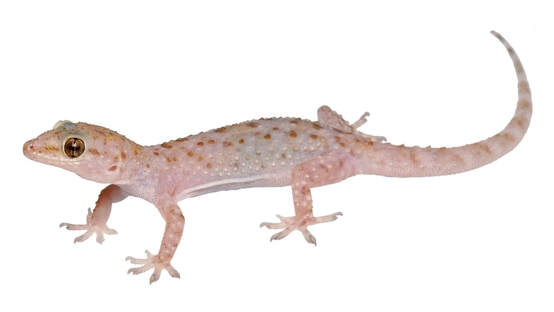
An adult Hemidactylus turcicus.
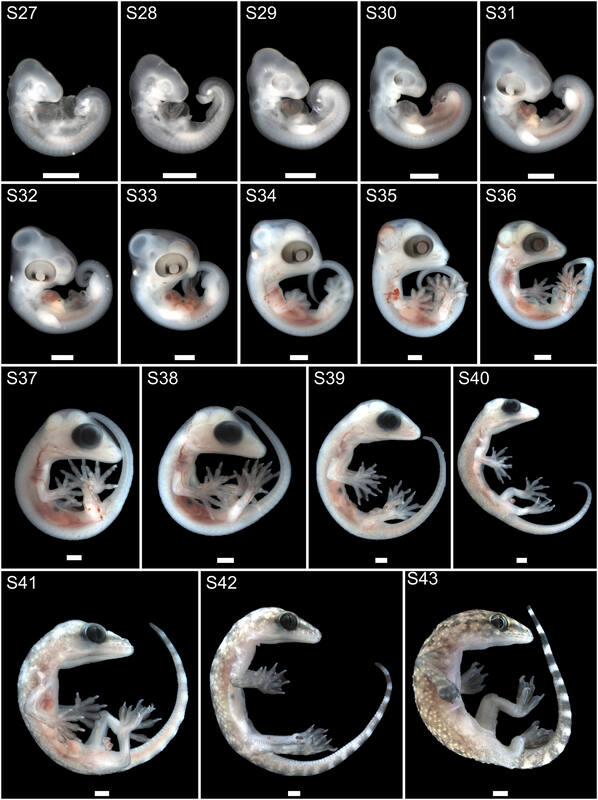
Seventeen developmental stages of Hemidactylus turcicus. Scale bars = 2 mm.
Hemidactylus platyurus — Flat-tailed house geckos
Flat-tailed house geckos are moderate-sized geckos native to Southeast Asia and introduced to parts of Florida, USA. Like many other species of Hemidactylus, they are most commonly commensal with humans and abundant in numbers, making them ideal for developmental studies. Not only do these geckos exhibit adhesive toe pads but they are particularly cool because they exhibit gliding membranes called patagia! We've described the skeletal development of paraphalanges and pigment development in this species. Most recently, we described external toe pad development in this and other Hemidactylus species.
Flat-tailed house geckos are moderate-sized geckos native to Southeast Asia and introduced to parts of Florida, USA. Like many other species of Hemidactylus, they are most commonly commensal with humans and abundant in numbers, making them ideal for developmental studies. Not only do these geckos exhibit adhesive toe pads but they are particularly cool because they exhibit gliding membranes called patagia! We've described the skeletal development of paraphalanges and pigment development in this species. Most recently, we described external toe pad development in this and other Hemidactylus species.
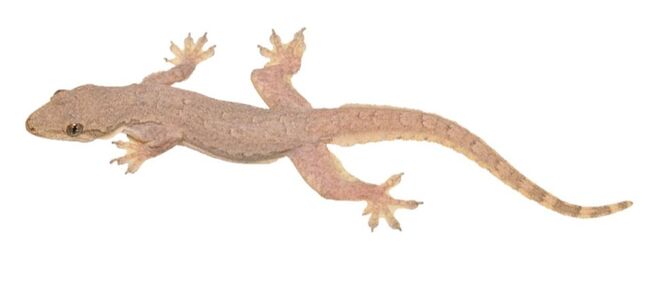
Adult Hemidactylus platyurus.
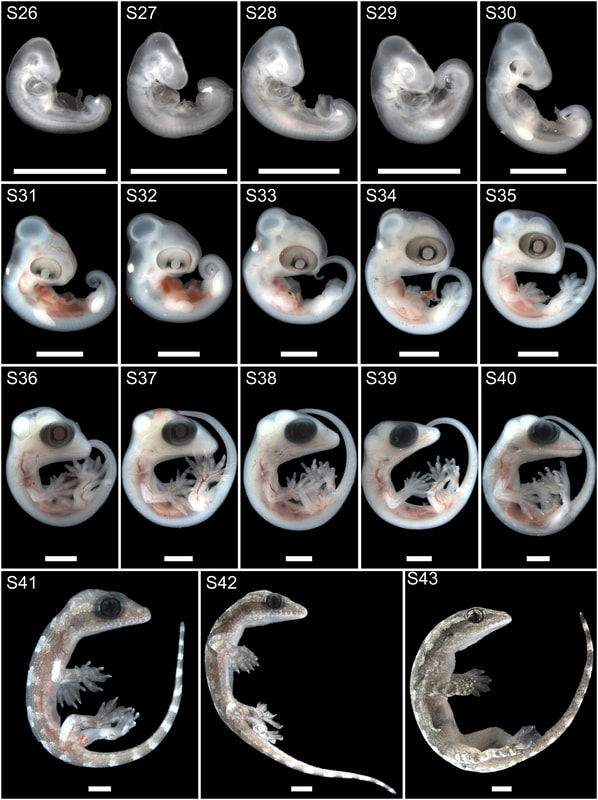
Eighteen developmental stages of Hemidactylus platyurus. Scale bars = 2 mm.
Hemidactylus imbricatus — Viper geckos
Viper geckos are small geckos native to the Indian Subcontinent. Unlike many other geckos in the genus Hemidactylus, H. imbricatus are primarily terrestrial and exhibit reduced adhesive pads. Most recently, we described external toe pad development in this and other Hemidactylus species.
Viper geckos are small geckos native to the Indian Subcontinent. Unlike many other geckos in the genus Hemidactylus, H. imbricatus are primarily terrestrial and exhibit reduced adhesive pads. Most recently, we described external toe pad development in this and other Hemidactylus species.
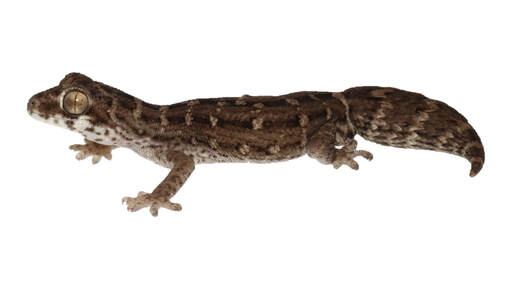
An adult Hemidactylus imbricatus.
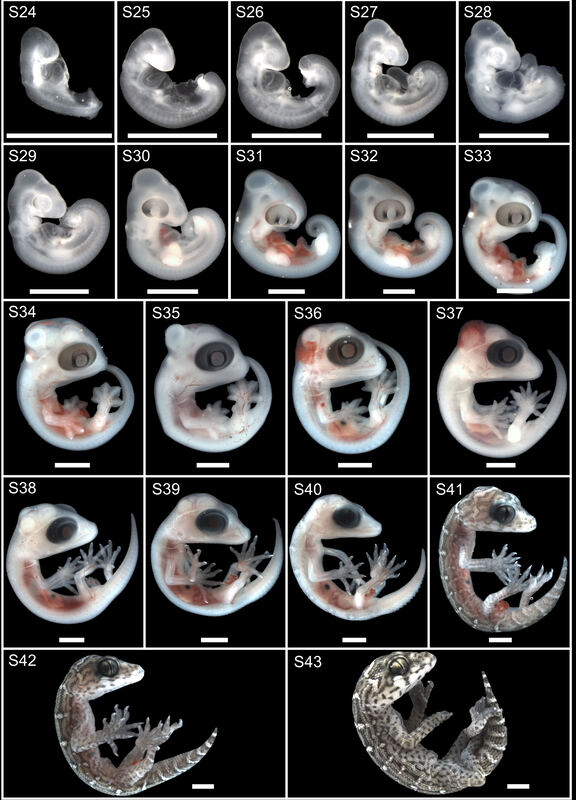
Twenty developmental stages of Hemidactylus imbricatus. Scale bars = 2 mm.