|
I am a NSF postdoctoral fellow at Princeton University studying morphological evo-devo and developmental genomics. My work generally focuses on reptiles, specifically geckos, as models to study the origins of morphological diversity.
See my "Publications" page or the summaries below for more about my research interests! |
|
How have organisms and their anatomical features achieved so many shapes and sizes? This central question of evolutionary developmental biology (i.e. evo-devo) drives my research.
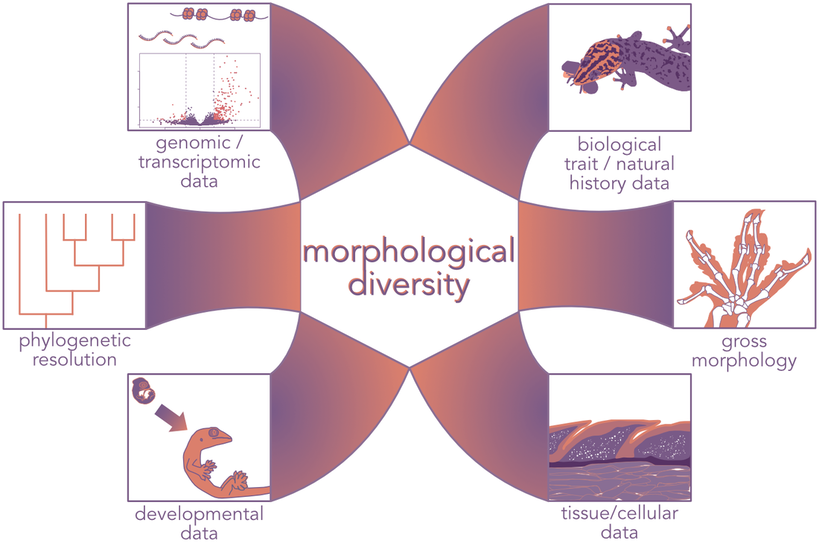
evolutionary and developmental morphology of skin and bones
Integument (i.e. skin) and mineralized structures (i.e. bones, teeth) are ubiquitous structures in vertebrates — providing protective barriers, an interactive medium for organisms, and functional foundations for movement. Much of my previous and ongoing work has focused on studying the repeated evolution of integumentary features (e.g. adhesive toe pads, osteoderms, gliding membranes) and skeletal features (e.g. skulls, phalanges) in geckos.
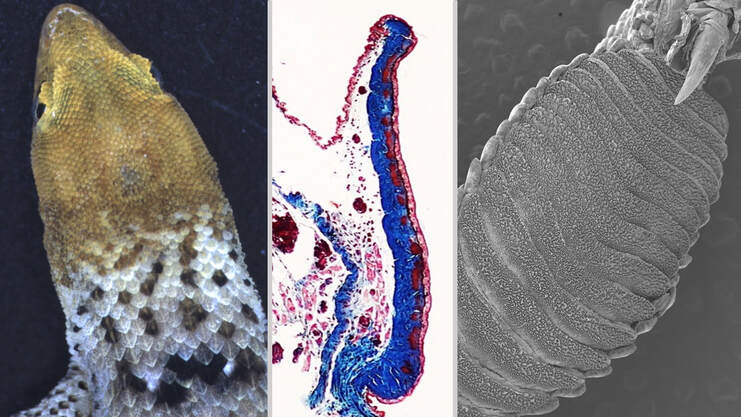
Diverse skin morphologies: diverse scale types and pigments (L), histology of
Geckolepis scales with osteoderms (M), SEM of adhesive gecko digits (R).
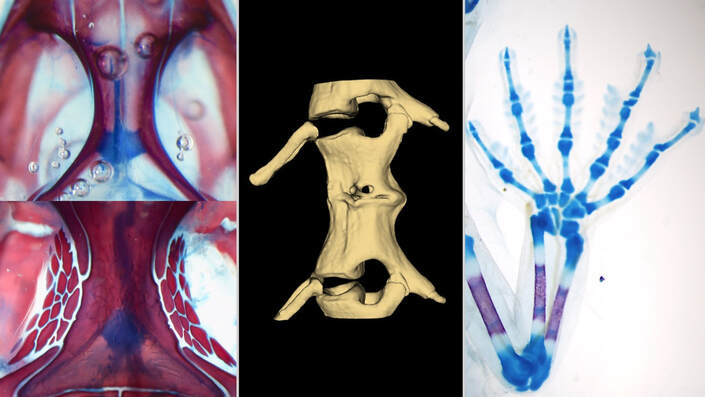
Diverse skeletal morphologies. Cleared and stained developing skull bones (L). µCT data of gecko vertebrae (M). Cleared and stained embryonic gecko arm (R).
lung development
Lungs are shockingly diverse in shape, size, and complexity across tetrapod animals. My current postdoctoral work focuses on uncovering the genomic basis for tetrapod lung diversity and generally characterizing reptile lung morphology through development.
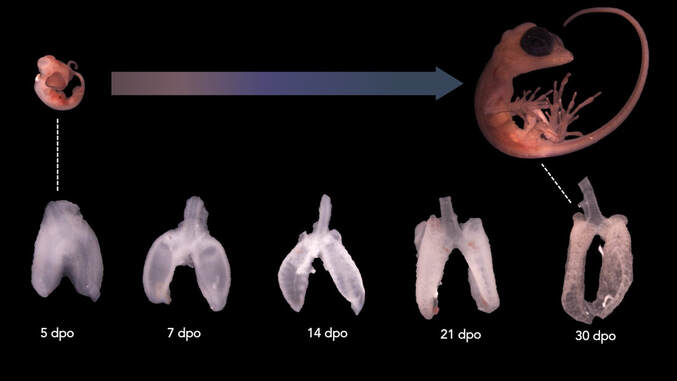
Anole lizard lung development.
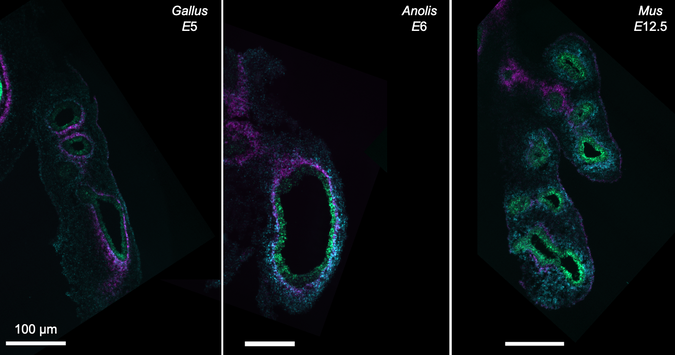
Fluorescent in situ hybridization of three important lung development genes in embryonic amniote lungs.
lizard embryology
Understanding the origins of morphological diversity is a central goal of evolutionary developmental biology — specifically, understanding how developmental pathways have been altered across evolutionary time. Such alterations to developmental pathways can result in drastic morphological change. My research utilizes classic embryological dissection and descriptions, alongside histological techniques and transcriptomics, to investigate how evolution has influenced the development of morphological novelty and convergence in geckos.
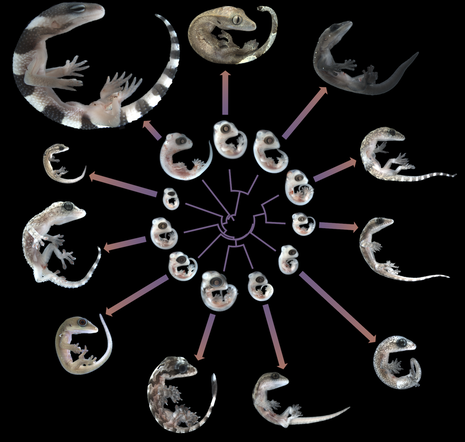
Gecko development in an evolutionary context.
gecko natural history
Geckos (Infraorder Gekkota) are a clade of lizards composed of over 2,200 described species — nearly 20% of known lizard and snake diversity! This charismatic group of lizards not only exhibit a suite of diverse, derived morphologies, but also exhibit an overall body plan that is considered similar to ancestral lizards. Many of these derived morphologies (e.g. adhesive toe pads) have evolved numerous times within gecko evolutionary history. Though my research primarily focuses on morphological development, robust phylogenetic hypotheses and a knowledge of natural history are critical to understand evolutionary and ecological contexts. For these reasons, phylogenetic methods, field collection, and field observation are major components of my research.
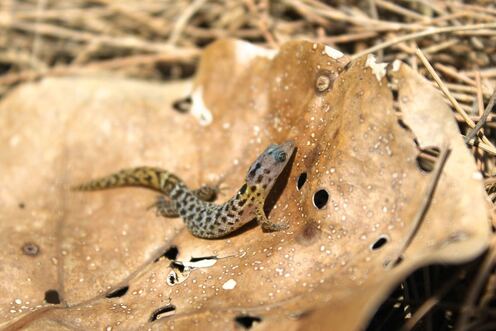
An Inagua gecko (Sphaerodactylus inaguae) from a field trip to the Bahamas in 2015.
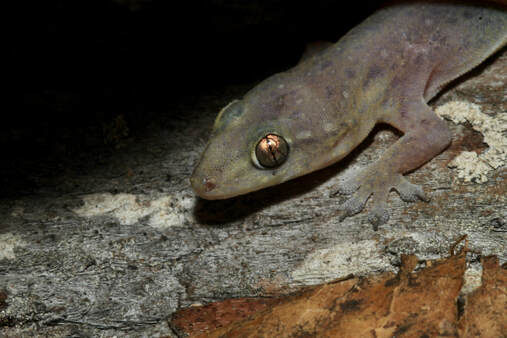
A four-clawed gecko (Gehyra mutilata) from a field trip to the Philippines in 2018.